We make jewelry boxes and linen trays for other people's brands. That means we see the buying process from the other side of the table, and we see where it goes wrong. Most problems with a custom jewelry box order don't come from bad luck. They come from choosing a supplier on the wrong things, usually the lowest unit price in the first email.
This is the checklist we would use if we were in your seat, sourcing jewelry packaging or jewelry storage for an Amazon, Shopify or Etsy brand, a boutique, or a gift box company.
1. Find out if you're talking to a factory or a trader
Neither is automatically bad. A good trading company can save you time if you need ten different products from ten different workshops. But for a custom jewelry box, where the details of board thickness, fabric wrapping and corner folding decide how the box looks, you want to be close to the people doing the work.
Ways to check:
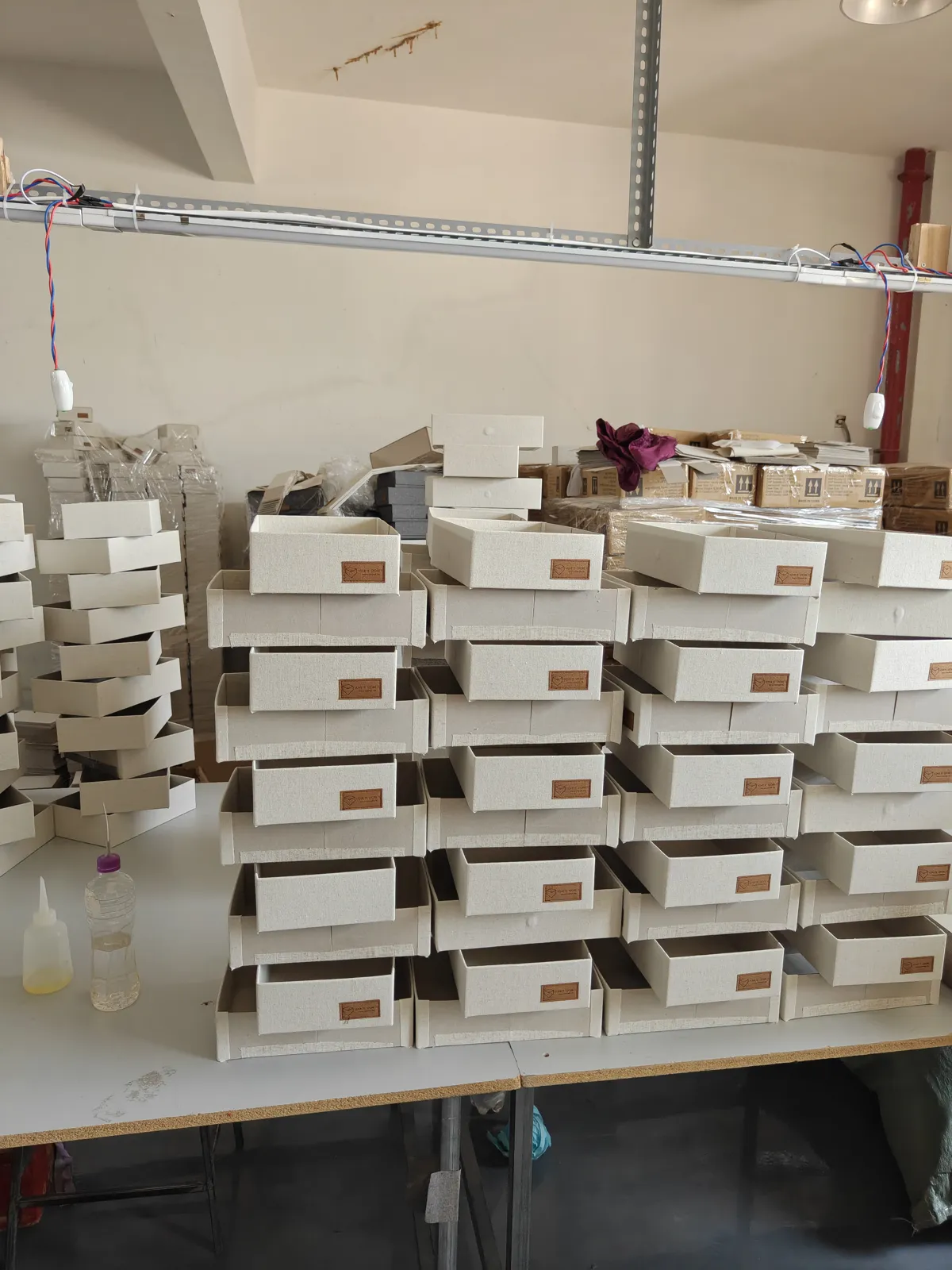
- Ask for photos or a short video of your type of product on their workbench, not studio shots. If they make linen trays, they should be able to show linen trays being wrapped.
- Ask a technical question, such as "What board thickness do you use for a 3-layer stackable box?" or "How do you keep the linen corners from lifting?" People who make the product answer quickly and specifically.
- Ask for a video call from the workshop floor. A factory can usually do this without much notice.
2. Look at what they actually specialize in
"Custom jewelry box manufacturer" covers a lot of ground: paper rigid boxes, plastic ring boxes, wooden cases, velvet pouches, leatherette storage boxes, display trays. Very few workshops do all of it well.
Look at the supplier's own product photos and ask yourself whether your product looks like the things they make every week. If you want a fabric-wrapped tray and their whole catalogue is printed paper gift boxes, they may still quote you, but your order becomes their experiment.
We say this about ourselves too. We mainly make two lines: hand-wrapped linen jewelry trays and organizers, and black PU leather stackable jewelry boxes with brass handles. We also make lidded boxes, travel cases and display trays. If you need a printed cardboard mailer, we're not the right workshop and we'll tell you so.
3. Judge them on the sample, not the quote
The quote tells you what they hope to charge. The sample tells you what you'll actually get. When the sample arrives, check:
- Corners and edges. Fabric should be tight and folded cleanly, with no glue showing and no lifting at the corners.
- Squareness. Put the tray on a flat table. It shouldn't rock. Stack the layers of a stackable box and see if they sit straight.
- Lining. Velvet or suede lining should be glued flat with no bubbles. Run your finger along the slots for rings and earrings.
- Hardware. Handles should be fixed firmly with no wobble and no sharp screw ends inside.
- Logo. Hot stamping should be crisp and even. Debossing should be the same depth all over.
- Smell. Glue and PU can smell when they're fresh. Ask how they handle this before packing.
Then ask the most important question: "Will the bulk order be made against this sample?" A good manufacturer keeps your approved sample on the production line and checks against it. If they're vague here, be careful.
4. Understand what drives the price
Two quotes for "a linen jewelry tray" can be far apart, and often both are fair. Price moves with:
- Board type and thickness
- Fabric: real linen, cotton-linen blend, or linen-look fabric
- Number of compartments and how complex the insert is
- Logo method: a leather tab, foil stamping, a metal plate
- Retail packaging: polybag, kraft box, printed box or magnetic gift box
- Quantity, because setup work is spread over more pieces
When you compare suppliers, put every quote into the same specification sheet. If one is much cheaper, find out which line is different. Usually it's the material, not some secret efficiency.
5. Ask about MOQ honestly, both ways
Many factories list a minimum order of 500 or 1,000 pieces per design. Some are flexible, especially when you use their existing sizes and materials and only add your logo. We don't set a fixed minimum; we quote based on what you want to change.
Be honest about your real numbers. If you need 200 pieces to test a listing, say so. A supplier who knows the truth can suggest a sensible starting point, like keeping a stock size and adding a logo tab, instead of quoting a full custom build you'll never reorder. We wrote more about this in our guide to MOQ and small trial orders.
6. Test the communication before you pay anything
You'll be messaging this supplier for weeks: drawings, colors, artwork, packing, shipping. Notice in the first few emails:
- Do they answer the question you asked, or send a catalogue?
- Do they ask you questions back, such as where you sell, what's going inside the box, or how it ships?
- Do they tell you when something won't work, or say yes to everything?
The supplier who pushes back a little at quote stage usually causes fewer problems at production stage.
7. Get the boring details in writing
Before you pay a deposit, confirm in writing:
- The approved sample (photos, and keep a physical one yourself)
- Materials, colors and logo method and position
- Packing method, carton size and labelling, including FBA labels if you need them
- Lead time counted from what point, sample approval or deposit
- Payment terms and trade terms
- What happens if goods don't match the sample
Also ask whether they'll sign an NDA if your design is new. Your artwork and designs should only be used for your orders.
8. Red flags we'd walk away from
- A price far below everyone else with no clear reason
- Refusing to make a sample, or wanting full payment before one
- Photos that are clearly taken from another brand's listing
- No answer when you ask to see the workshop
- Changing the specification after the sample without telling you
The short version
Pick a manufacturer whose everyday work looks like your product. Judge them on the sample and on how they communicate, not just the unit price. Be open about your quantities and timing, and put everything in writing before production starts.
If you're sourcing linen jewelry trays, stackable leather jewelry boxes or another custom jewelry box, send us your idea and rough quantity. We'll reply with a price and an honest opinion on what's worth customizing and what isn't.