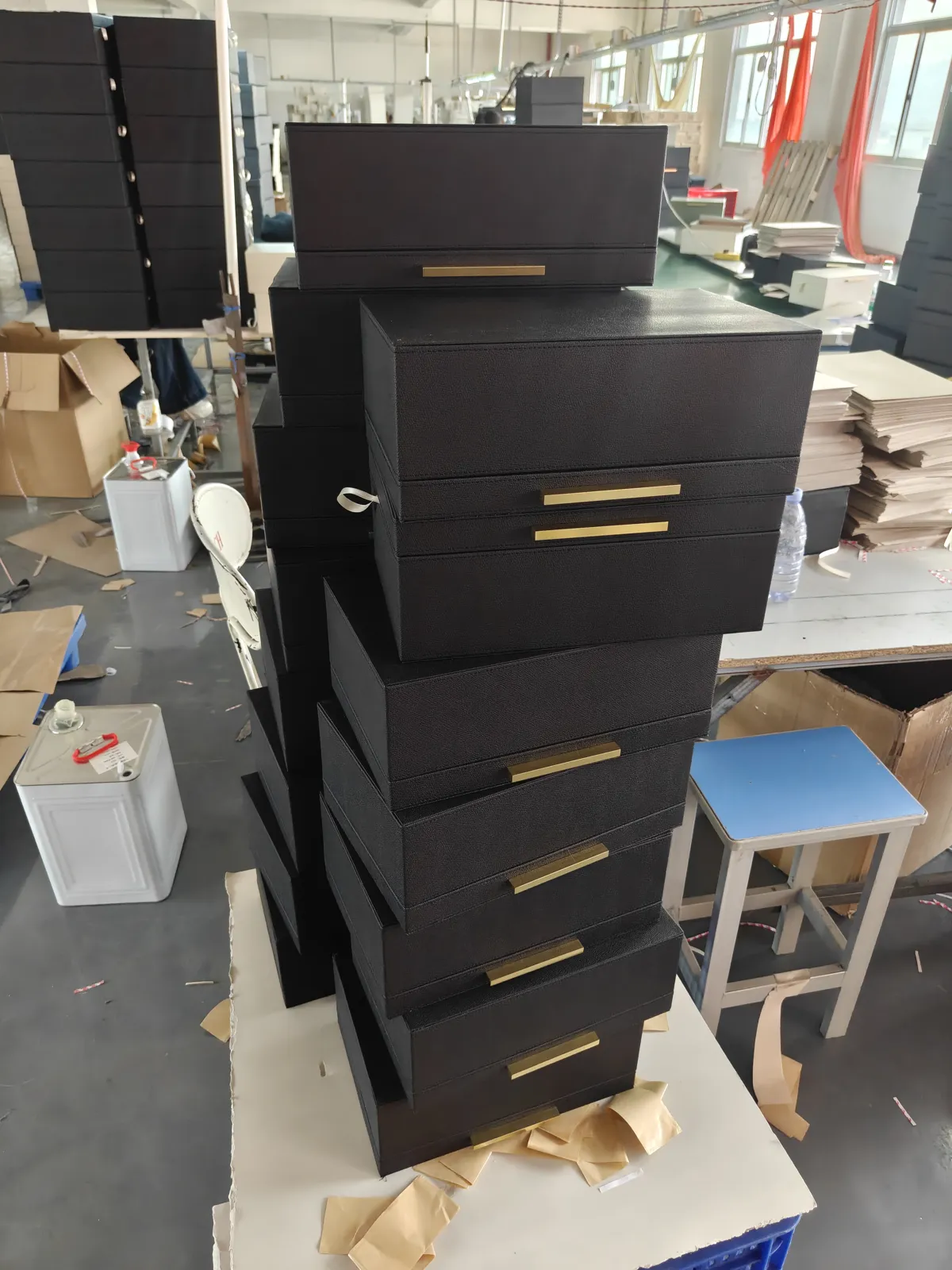
"Which material should I use?" is one of the first questions we get from brands ordering custom jewelry boxes. We wrap linen, PU leather and velvet over board every week, so here is how we actually think about the three, including the trade-offs nobody puts on a product listing.
Short answer: there's no best material. There's the one that fits your brand, your price point and how the box will be used.
How a fabric-wrapped jewelry box is built
Most of what we make has the same core: rigid grey board, cut to size, glued and assembled into a tray or box. The outer material is then wrapped over that board by hand, with the corners folded and pressed. Inside goes a lining, usually velvet or microfiber suede, plus any inserts like ring rolls, earring slots or dividers.
So when you choose linen, PU or velvet, you're mostly choosing the outside skin. The structure underneath can be similar. That matters because a cheap material on a well-made board often looks better than an expensive one on a weak board.
Linen
Linen has a natural, woven texture and soft, muted colors: beige, oatmeal, grey, cream, sage. It reads as calm, home-like and a little handmade.
Where it works well
- Drawer organizers and open jewelry trays
- Home and lifestyle brands, minimalist or "Scandi" looks
- Gift sets where the box stays in use as storage
- Sellers on Amazon, Etsy or Shopify whose photos lean natural and light
Things to know
- Real linen and linen-look fabrics are both used. Real linen has more irregular slubs. Linen-look fabric is more even. Ask which one you're being quoted, because it changes both price and look.
- Light colors show dirt more easily than dark PU. For trays that get handled every day, a mid-tone like oatmeal or grey is forgiving.
- Linen doesn't take foil stamping as crisply as smooth PU, because the weave is uneven. That's why our linen trays use a leather or PU tab for the logo. The tab is stamped or debossed, then fixed to the front.
PU leather
PU leather (also called leatherette or faux leather) is a coated fabric. It comes in many grains: smooth, textured, saffiano, croc-style. Our black stackable jewelry boxes use a textured black PU with brushed brass handles.
Where it works well
- Stackable jewelry boxes and jewelry cases that need to look structured and "finished"
- Watch boxes, travel cases, men's accessories
- Brands that want a premium or classic look without real leather
- Products that get handled a lot, since it wipes clean
Things to know
- PU varies a lot in thickness, feel and how well it ages. A thin, shiny PU can look cheap quickly. Always judge it from a physical swatch, not a photo.
- It takes hot stamping and debossing well, especially smooth or fine-grain PU. A gold or silver foil logo on black PU is a classic for a reason.
- Fresh PU and glue can smell. Ask your supplier how long goods air out before packing, especially if your customers will open the box at home.
- If your market expects vegan or animal-free materials, PU can help. Don't make claims about recycled content or chemical testing unless your supplier can back them with paperwork.
Velvet
Velvet has a soft pile that catches light. It feels luxurious and traditional, and it's what many people picture when they think "jewelry box".
Where it works well
- Ring boxes, pendant boxes and presentation boxes
- Fine jewelry and bridal, where the unboxing moment matters
- Display trays for counters and trade shows
- Linings, inside linen and PU boxes alike
Things to know
- Velvet shows dust, lint and finger marks, especially in dark colors. As a lining that's fine. As an outer surface on a box that's handled daily, it can wear at the edges.
- Wrapping velvet cleanly around corners takes more care than flat fabric, because the pile can crush or show seams.
- Logos usually go on as foil stamping or a metal plate. Fine detail can get lost in the pile, so keep the logo simple.
A quick side-by-side
- Look: linen is natural and soft; PU is structured and sleek; velvet is plush and classic.
- Everyday wear: PU is easiest to wipe clean; linen is fine in mid-tones; velvet shows marks most.
- Logo: linen works best with a leather or PU tab; PU suits foil, deboss or a metal plate; velvet suits foil or a metal plate.
- Best for: linen for trays, organizers and home storage; PU for stackable boxes, cases and watch boxes; velvet for ring and presentation boxes, display trays and linings.
What actually drives the cost
People often assume the material is the biggest cost. Sometimes it is, but just as often the price is driven by:
- Size, and how much board and fabric each piece uses
- The number of compartments and inserts
- Hardware like handles, clasps and mirrors
- The logo method
- Retail packaging
- Quantity
So rather than picking the "cheap" material, decide on the look and use first, then ask your manufacturer where to save. For example, a simpler insert or a standard size might save more than switching from PU to linen.
Mixing materials
You don't have to choose just one. Some combinations we make often:
- Linen outside, velvet or suede lining in a contrasting color
- PU outside, velvet lining, brass handles
- Linen tray with a PU leather logo tab in a darker tone
Mixing lets you get the look of one material and the practical benefits of another.
How to decide
- Look at your brand photos. Is it light and natural, or dark and polished?
- Think about use. Will the box sit in a drawer, be carried, or be opened once as gift packaging?
- Decide on the logo method you want, because that narrows down the surface.
- Ask for physical swatches. Colors on screen are never exact.
- Order a sample in your top one or two choices before you commit.
If you're torn between linen and PU for a tray or a stackable box, tell us what you sell and how you photograph it. We'll send our suggestion, and swatches go out with your sample so you can see them side by side.