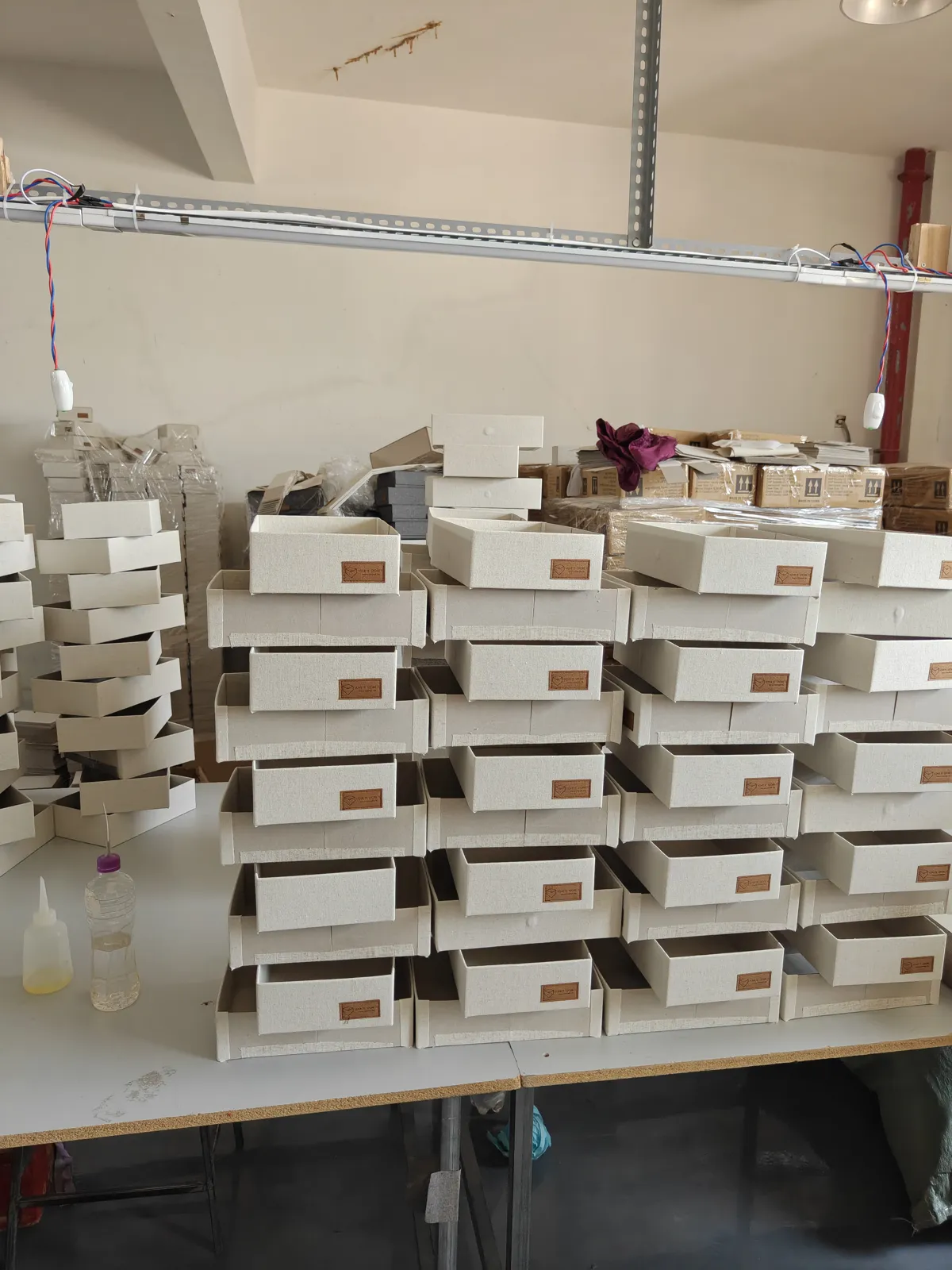
Linen jewelry trays are one of the products we make most weeks. Brands use them as drawer organizers, counter displays, gift-set inserts and private-label storage. If you are looking at linen jewelry tray wholesale for your own line, the useful questions are practical: which size, which fabric, how the logo goes on, and whether you start from a stock size or a full custom build.
We also make black PU stackable jewelry boxes with brass handles, but this piece stays on open linen trays and organizers.
What a linen jewelry tray is actually for
An open linen tray is rigid board wrapped in linen (or linen-look fabric), usually lined with velvet or microfiber suede, then fitted with compartments, ring rolls or soft pads. Most have no lid. Buyers want something that sits in a drawer or on a dresser and stays in daily use.
Common uses from US, UK, EU and AU buyers:
- Brand jewelry organizers sold on Shopify, Amazon or Etsy as home storage
- Retail counter trays for boutiques and pop-ups
- Gift-set inserts inside a larger outer box, so the tray becomes the keepable part
- Jewellery travel or hospitality trays that need a soft, natural look
If you need a closed case that stacks like a full jewelry box, linen is often the wrong outer skin. For that we usually point people toward PU leather. We compared the materials in linen vs PU leather vs velvet for jewelry boxes.
Sizes and compartment layouts
Tray size depends on what you sell and how you photograph it. Most private-label orders fall into a few useful ranges.
Small trays roughly phone-width or a bit wider. Good for rings and earrings, or as a gift insert. Easy to ship and style in flat-lay photos.
Medium trays with several rows of compartments. This is the everyday jewelry organizer size: rings, earrings and bracelets, sometimes a longer channel for a watch or necklace.
Large or multi-section trays for dresser tops and retail displays. More board and fabric means higher unit cost, but the product looks more substantial in photos.
Compartment options matter as much as outer size: fixed dividers for mixed jewelry, soft ring rolls, earring slots, or open pads with no hard dividers for a cleaner look.
When you ask for a quote, send a rough sketch or a photo of a tray you like, plus the jewelry types that must fit. We can say whether a stock inner layout works or whether the insert needs a custom cut. Many first orders keep a proven layout and only change the outer fabric and logo.
Fabric: real linen, cotton-linen blend, or linen-look
"Linen tray" on a product page can mean three different skins. Ask which one you are being quoted.
Real linen has a natural weave with small slubs and slight color variation. It photographs well for home and lifestyle brands. It is usually the most expensive of the three, and light shades show handling marks sooner.
Cotton-linen blends keep much of the natural look at a more stable price. The hand-feel is still soft, and the weave is usually more even than pure linen. Common for wholesale runs that want the look without pure linen on every piece.
Linen-look fabric is made to read as linen in photos. It is more even, often tougher in daily use, and usually the most cost-effective. For mid-tone greys and oatmeal it can be hard to tell from a blend on a phone screen. Always judge from a physical swatch.
Color tip from the floor: cream and pale beige look beautiful in studio light but show dirt faster. Oatmeal, taupe and soft grey forgive fingerprints and shelf dust better.
Logo options that work on linen
Linen weave is uneven, so fine foil stamping directly on the fabric rarely looks as crisp as on smooth PU. Most of our branded linen trays use one of these methods.
Leather or PU tab. A small tab, often in darker brown or black, is stamped or debossed, then fixed to the front. This is the method on most of our production photos. It reads clearly and does not fight the fabric texture.
Hot stamp / foil on a smooth patch. Sometimes a small smooth area takes the foil. Keep the logo simple so thin strokes do not break up.
Metal plate. A thin metal logo plate riveted or glued on. Strong for premium positioning, higher cost, and best when the brand mark is simple.
For a first private-label run, a leather tab on a stock tray size is usually the fastest path to something that looks like your brand. Send the logo file early and say whether placement must match left/right options for photography.
Lining and how the inside should feel
The outside sells the photo. The lining sells the unboxing and daily use.
Most trays we ship use velvet in a contrasting or matching tone, microfiber suede for a flatter modern feel, or soft pads where hard dividers are not needed. Check that the lining is glued flat with no bubbles, that compartment edges are clean, and that ring rolls sit firmly.
If your jewelry is especially fine, ask for a lining that will not catch or scratch. We can adjust pad density and fabric type on the sample before you lock the bulk order.
How brands usually start: stock size + logo vs full custom
Full custom — new outer size, new insert cutting die, new color, new packaging — makes sense when you already know the product sells. For a first listing or small test, most of our buyers do something simpler:
- Pick a stock outer size we already make well
- Choose fabric color from swatches
- Add a logo tab or plate
- Keep a standard compartment layout
- Order a small trial quantity, then scale if the listing works
That approach is cheaper and faster than redesigning everything at once. We wrote about quantities in MOQ and small trial orders for private-label jewelry packaging. Small trial orders are welcome; we would rather start with a sample you approve than push a large first run you are still unsure about.
Full custom fits when your photography needs a specific footprint, your jewelry does not fit standard slots, or you are building a matching set (tray + stackable box + travel case) that must share dimensions.
What to check when the sample arrives
Do not approve from photos alone. When the sample lands:
- Set it on a flat table. It should not rock.
- Press the corners. Fabric should be tight, with no lifting and no glue stains.
- Open every compartment and run a finger along the edges.
- Check the logo tab or plate for alignment and even stamp depth.
- Compare the fabric to your swatch under daylight and under your product lights.
- Ask, in writing, whether bulk will be made against this approved sample.
If anything is off, say so before you sign off. Changing a corner fold or logo position after bulk is running is expensive for everyone. For a wider checklist, see how to choose a custom jewelry box manufacturer.
Ready for a quote
If you want a linen jewelry organizer under your brand, send us the target outer size (or a photo of a tray you like), the jewelry types that must fit, preferred fabric and color direction, logo file and method (tab, foil, or plate), and rough quantity for the first run.
Ask for a quote through our contact form. We will reply with options at a couple of quantities, note what is stock versus custom, and say honestly if a simpler first version will get you to market faster.